Card game design / 2026
Duel
Duel is a two-player card game that simulates a Japanese sword duel. Two duelists stand on a 15-space track. Before each exchange, both players secretly plan three moves, a stance and a technique for each slot. During play they reveal their stances, choose where to step and get one chance to dodge before the planned techniques are revealed and resolved. You never know your opponent's move until it is revealed, and by then you may already have lost.
Process
The core of the game is reading your opponent. A plan cannot be changed once it is locked, so players have to work out what the other player will do and control the distance so that their own attacks land and their opponent's miss. The idea comes from how real duels work: an exchange is decided in the stand-off, not improvised after the other blade moves. The game is inspired by the duel at Ganryu-jima in 1612, where, according to legend, Miyamoto Musashi used the low sun to blind Sasaki Kojiro; this became the weather card. Another influence is Norio Nanjo's novel Suruga Castle Tournament.
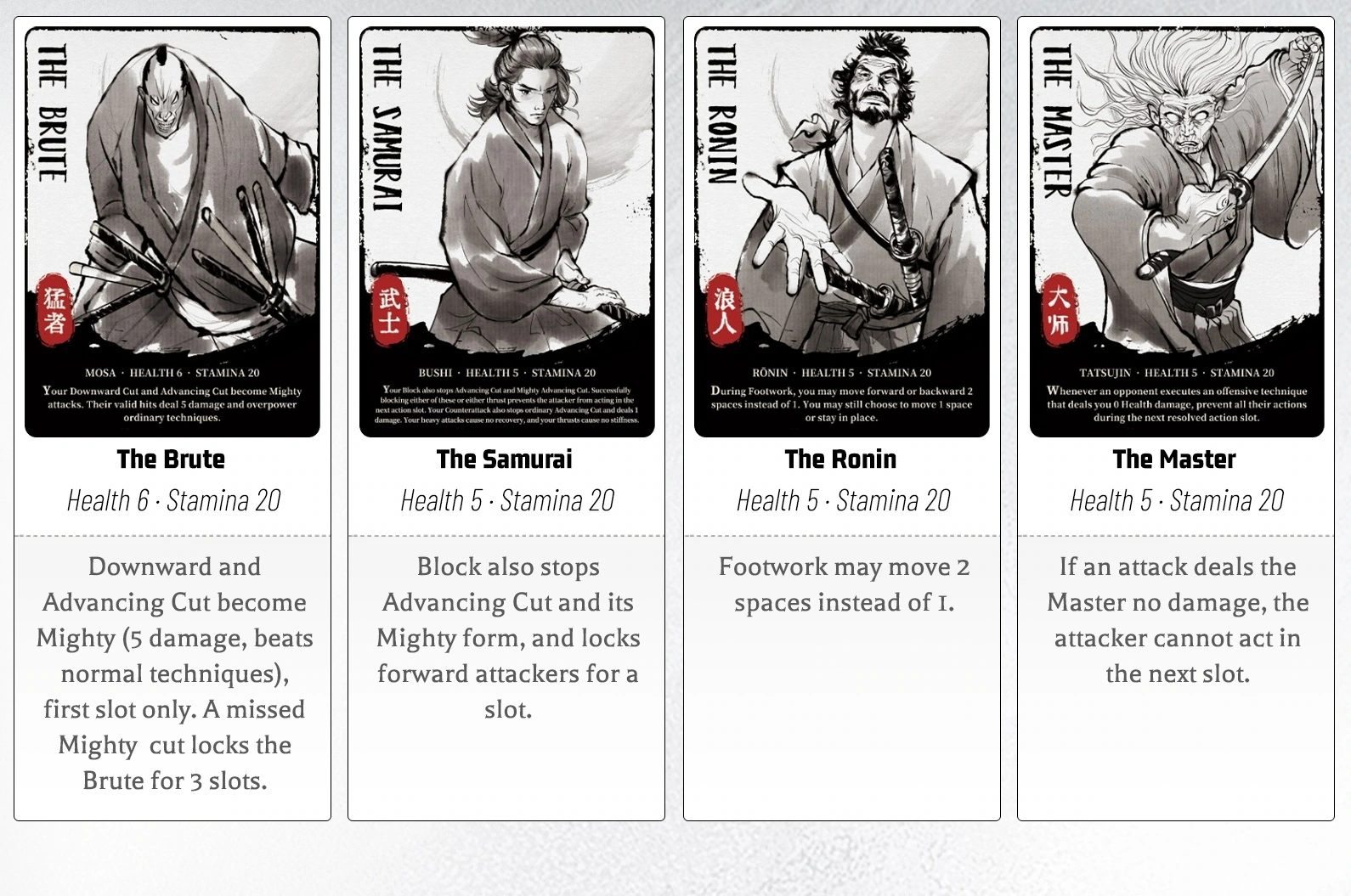
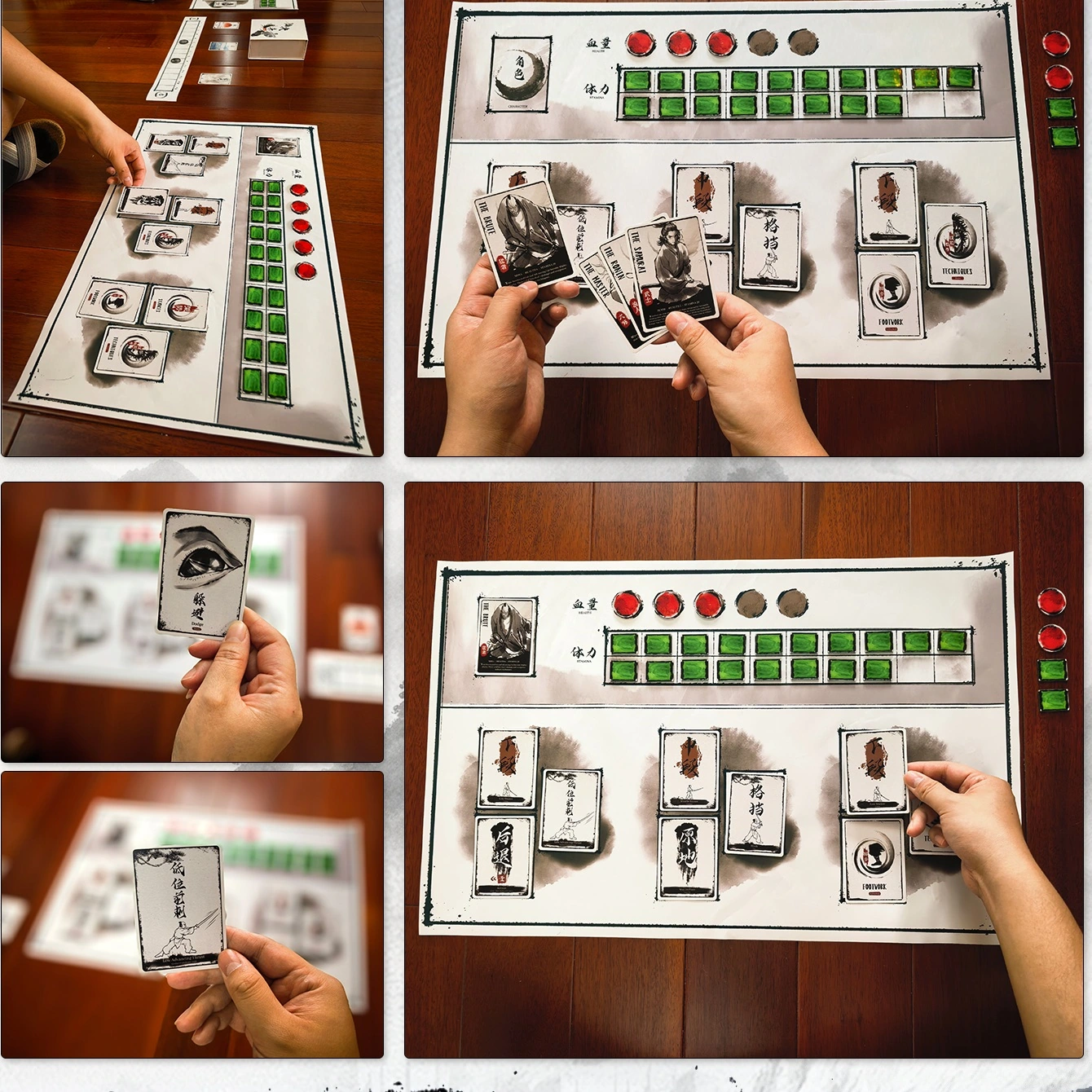
Four duellists, the Brute, the Samurai, the Ronin and the Master, each have a special ability, and three weather types (morning sun, rain and fog) change what players can see and how far they move. The cards cover characters, stances, techniques, footwork, dodges and weather, in an ink-wash style with red accents.
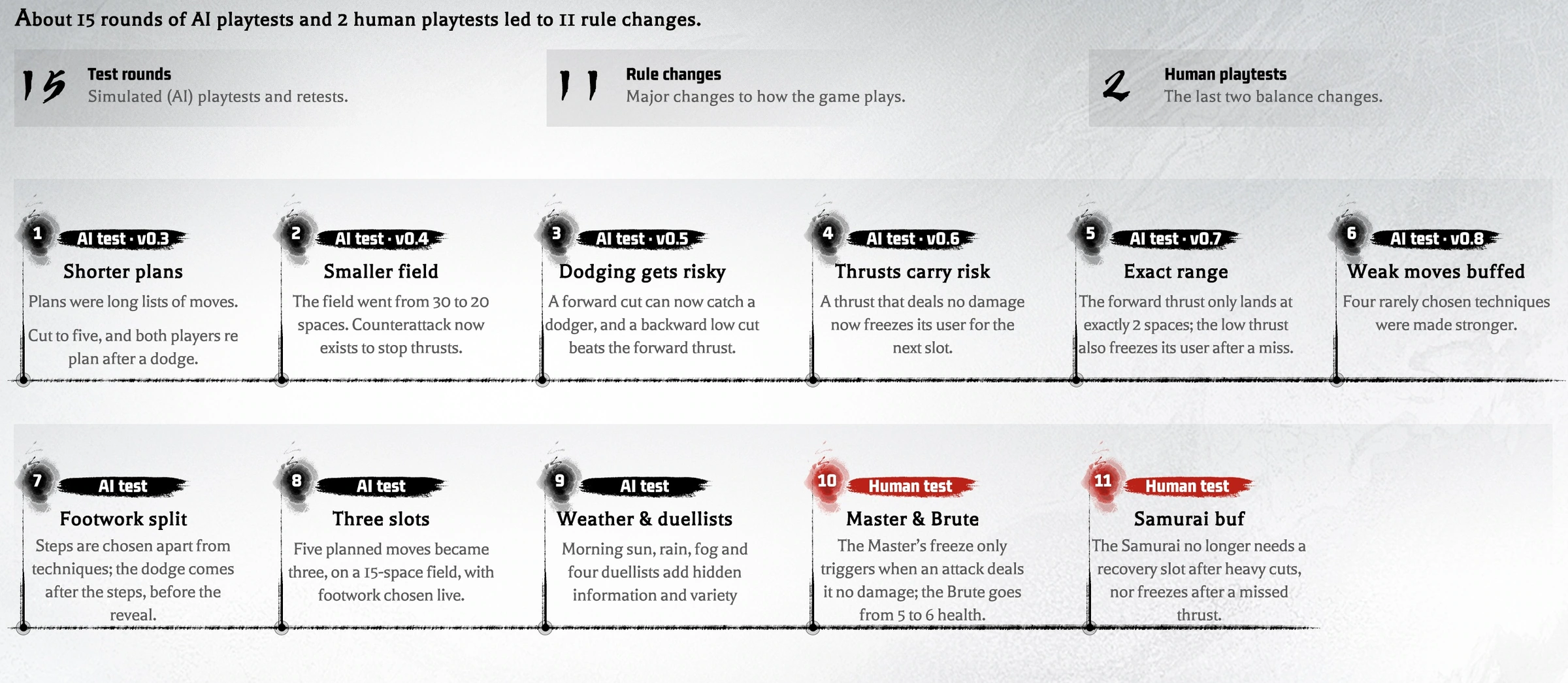
I tested the rules with about 15 rounds of AI playtests, in which computer players played up to 2,000 games of a rule set to find moves that were too strong or never used, plus two human playtests. Together they led to 11 rule changes, such as cutting long move lists down to three planned slots, shrinking the field to 15 spaces and rebalancing the Master and the Brute.
Rules and development
A duel planned before the blades move
The design centres on reading an opponent's stance and controlling distance before revealing an attack. A locked plan cannot be improvised away after the other blade moves. Rain, footwork and the uncertainty of a stand-off turn a narrow track into a contest of anticipation.
Scroll horizontally to see all columns.
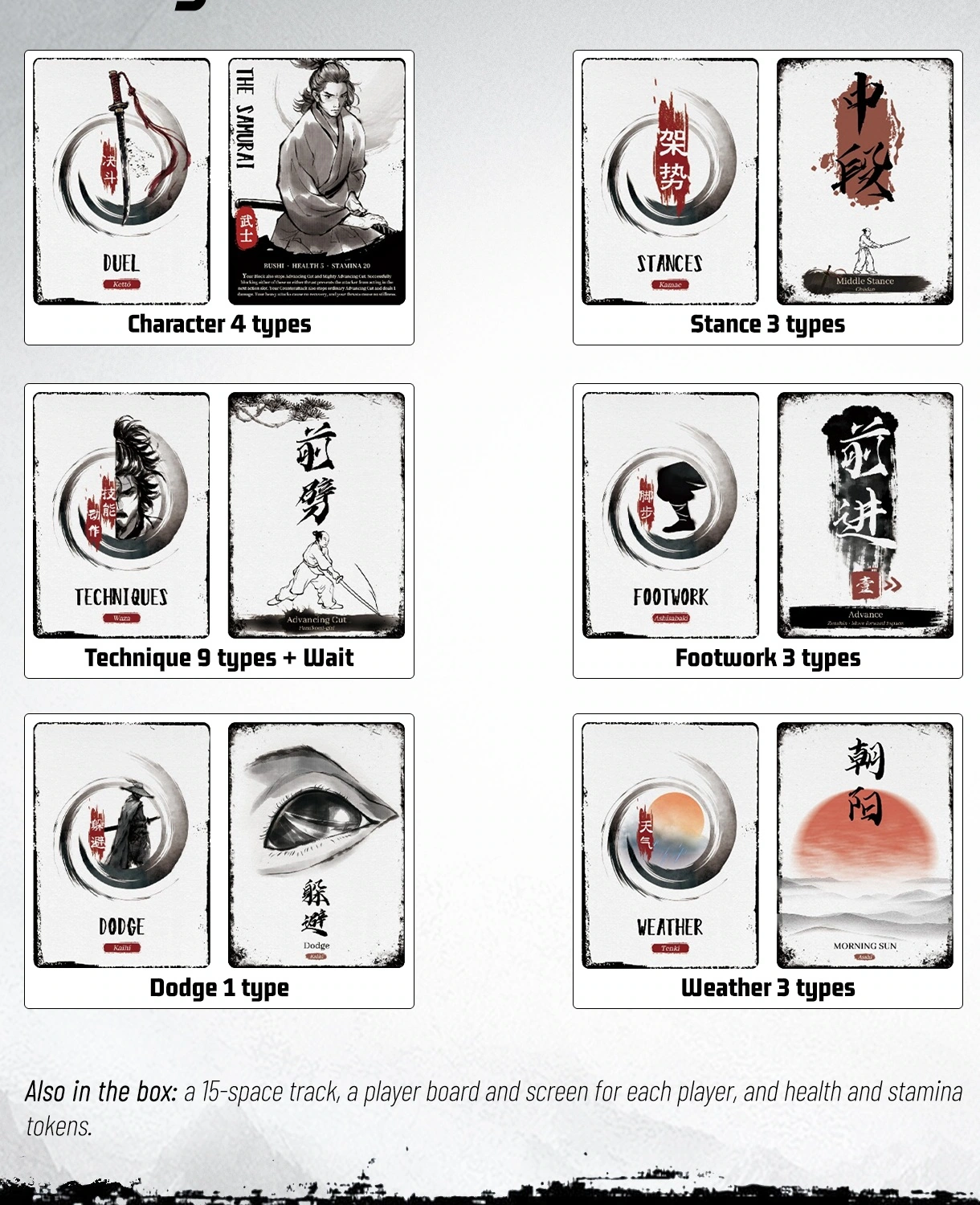
| Card family | Types |
|---|---|
| Characters | 4 duellists |
| Stances | High, Middle and Low |
| Techniques | 9 techniques plus Wait |
| Footwork | Toward, Stay and Away |
| Dodge | 1 type |
| Weather | Morning sun, rain and fog |
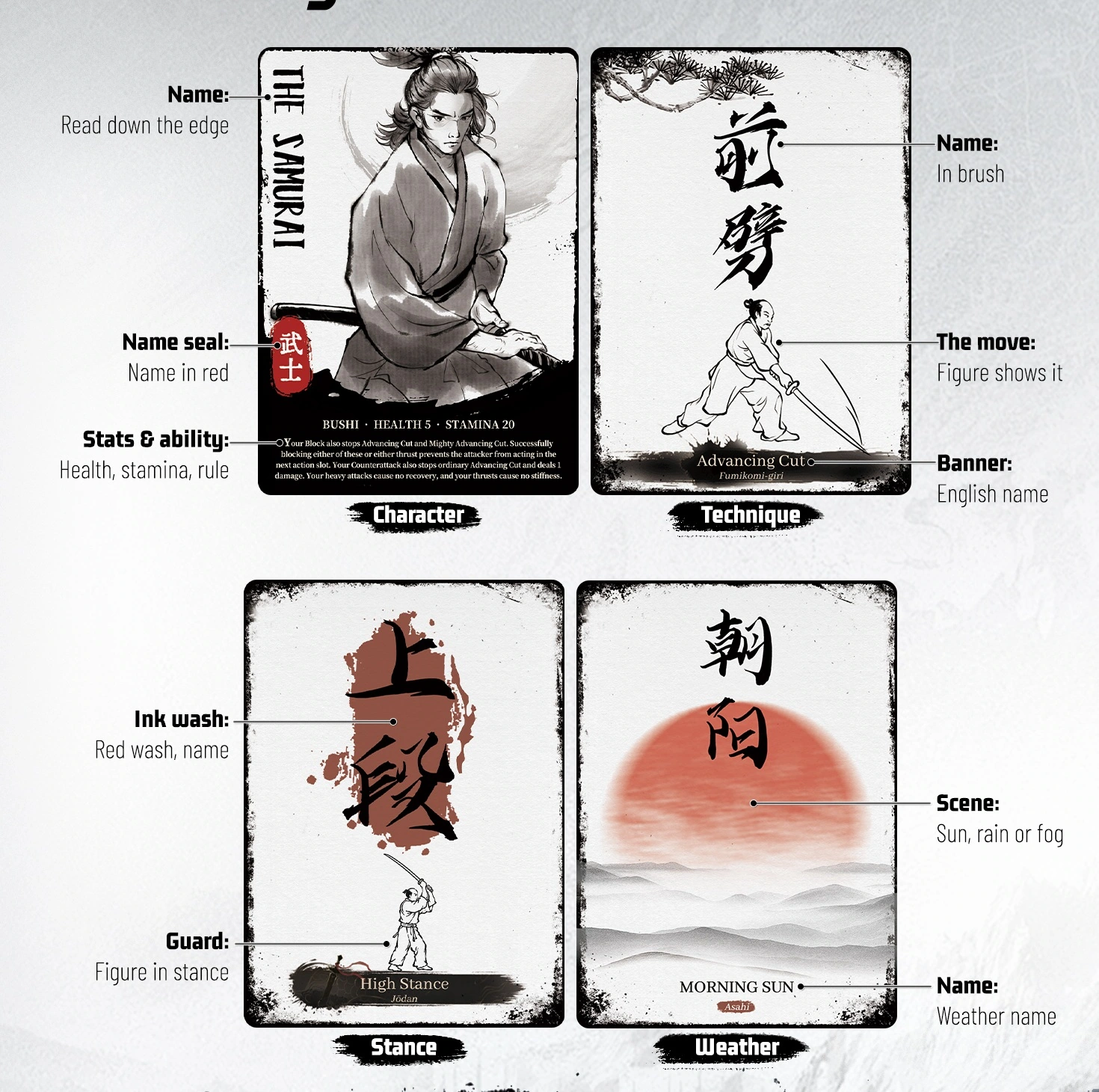
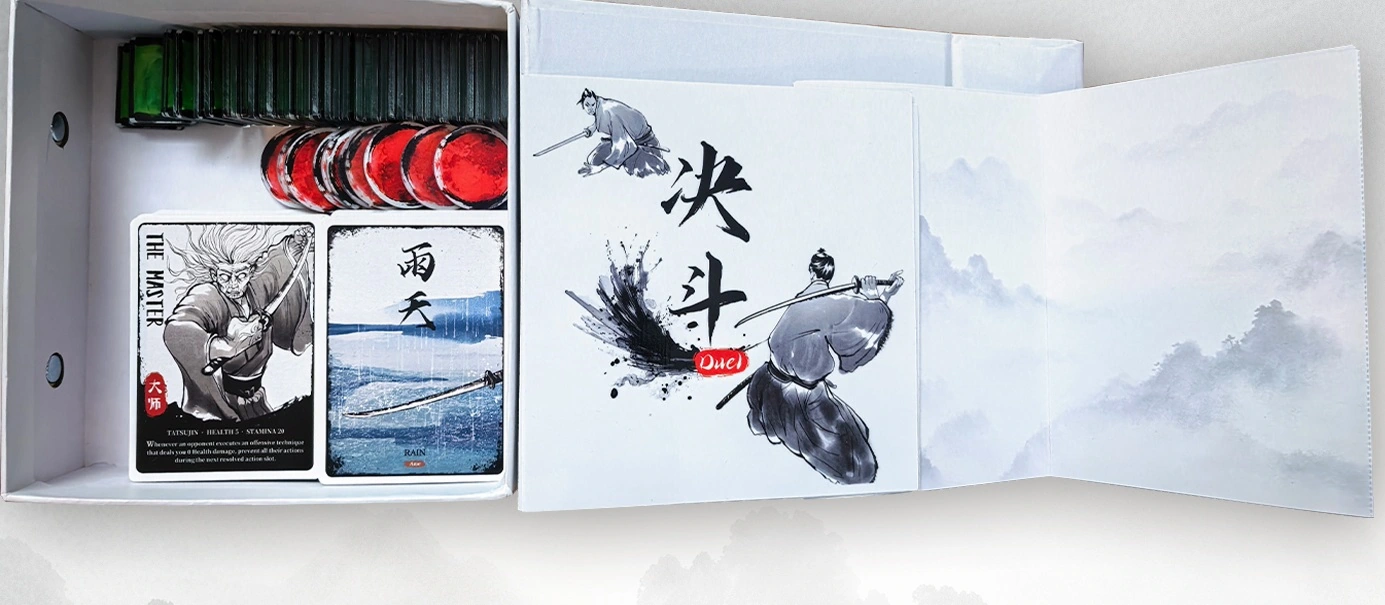
The printed set contains 109 cards, a 15-space track, a player board and screen for each player, and health and stamina tokens. Ink-wash imagery and red seals connect the card families. Character names run down the edge; a lower panel gives health, stamina and ability. Technique illustrations show the move above an English-name banner, while stance cards show the guard and weather cards show the conditions.
Setup and a new face-off
Choose a duellist
Both players choose secretly and reveal together.
Place the pieces
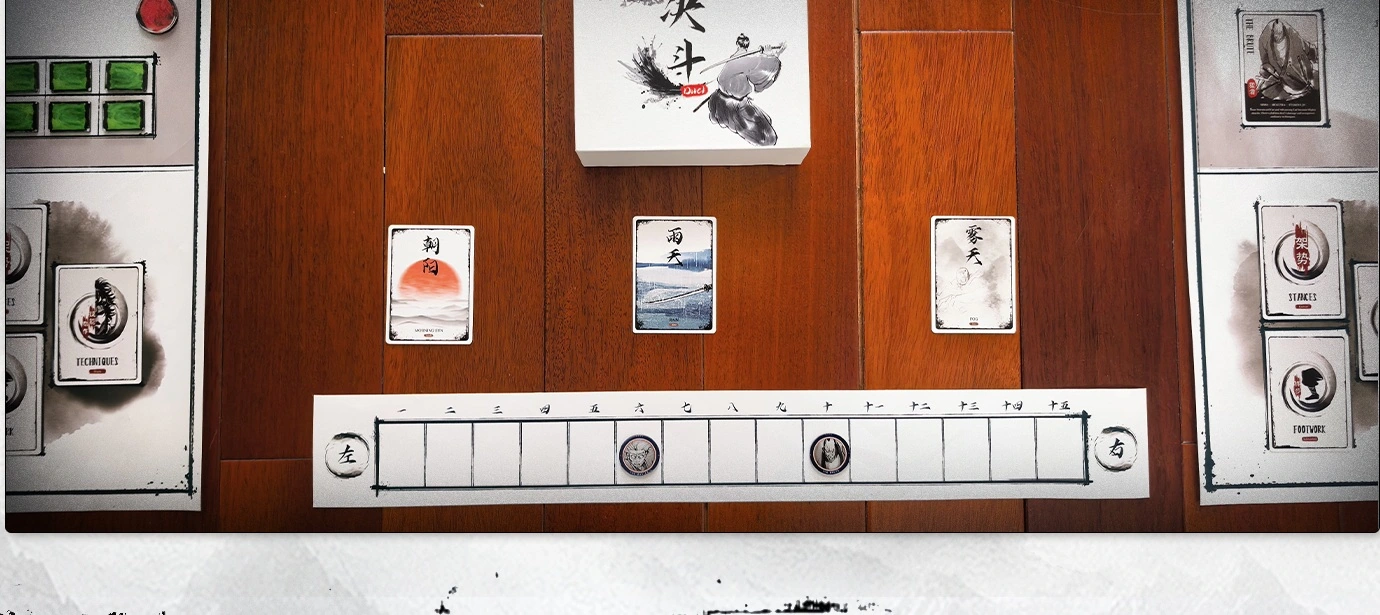
Player A starts on space 6 and player B on space 10: four spaces apart on the 15-space track.
Set health and stamina
Each starts with 5 health, except the Brute with 6. Both start at the maximum of 20 stamina.
Plan three slots
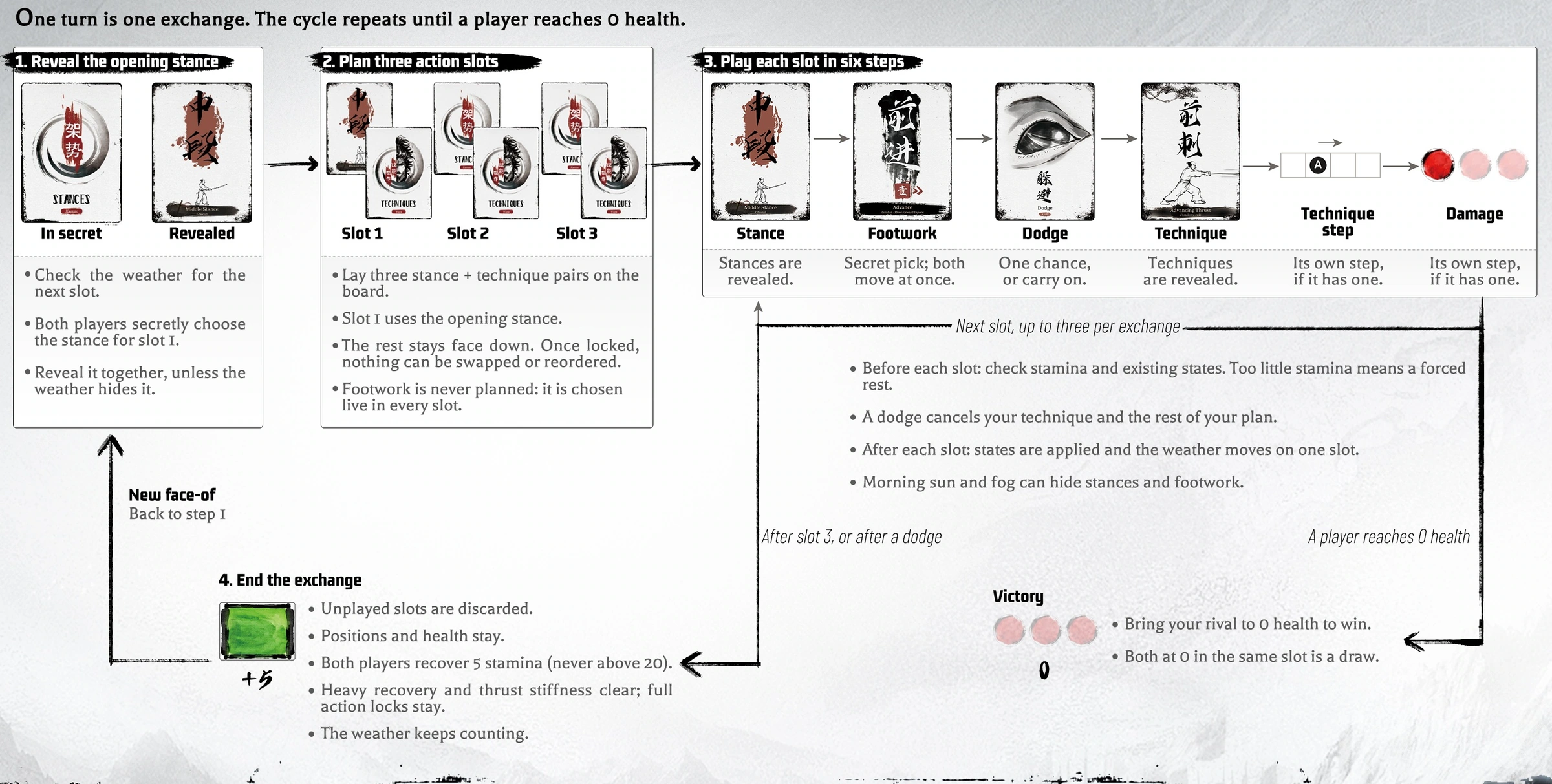
Check the weather for the next slot. Secretly choose the opening stance, reveal it unless the weather hides it, then lock three stance-and-technique pairs. Slot 1 uses the opening stance; the rest remain face down. No swapping or reordering is allowed.
Screens go up for secret choices and down for reveals. Stances change only one step at a time: High and Low cannot switch directly. Wait may be planned without a technique. Footwork is chosen live in each slot, never as part of the locked plan.
Six steps in each action slot
Before each slot, check stamina and existing states. Insufficient stamina forces a rest. Each exchange has up to three slots, resolved in this order:
Stance
Reveal the planned stances.
Footwork
Choose a step secretly; both players move at the same time.
Dodge
Each player has one chance to dodge or continue.
Technique
Reveal the locked techniques.
Technique step
Resolve any movement belonging to the technique itself.
Damage
Check range at the final positions and apply damage to both players simultaneously.
Apply states after damage and advance the weather by one slot. An exchange ends after slot 3 or after a dodge; discard unplayed slots. Positions and health remain. Both players recover 5 stamina, capped at 20. Heavy recovery and thrust stiffness clear, full action locks remain, and the weather count continues into the next face-off.
Reduce the opponent to 0 health to win. If both reach 0 in the same slot, the result is a draw. Cornering or exhausting an opponent does not win by itself.
Footwork, dodge and pursuit
Footwork is free: step one space toward the opponent, stay, or step one space away. The Ronin may move two instead. Spaces 1 and 15 are walls. If both would finish on the same space, neither moves. Footwork happens before a technique's own step.
A dodge costs 1 stamina and moves back two spaces, or three in rain. It requires clear space behind the player and cannot be used during a full action lock, thrust stiffness or forced rest. Dodging cancels that player's technique and the rest of the plan.
Only Advancing Cut, Advancing Thrust and Low Advancing Thrust can pursue a dodger. They can still hit if the dodger finishes within three spaces after the attacker's step. Advancing Cut retains 5 damage; either pursuing thrust deals 1.
Techniques and their costs
Scroll horizontally to see all columns.
| Stance | Technique | Own step | Range / role | Damage | Stamina |
|---|---|---|---|---|---|
| High | Downward Cut | 0 | 1–2 | 5 | 2 |
| High | Advancing Cut | Forward 1 | 1–2 | 5 | 2 |
| High | Retreating Cut | Back 1 | 1–2 | 2 | 2 |
| Middle | Counterattack | 0 | Defensive | 1 back | 1 if it works |
| Middle | Advancing Thrust | Forward 1 | Exactly 2 | 2 | 2 |
| Middle | Block | Back 1 | Defensive | 0 | 1 if it works |
| Low | Horizontal Cut | 0 | 1–2 | 1 | 1 |
| Low | Retreating Horizontal Cut | Back 1 | 1–2 | 1 | 2 |
| Low | Low Advancing Thrust | Forward 1 | 1–2 | 2 | 2 |
| Any legal stance | Wait | No technique | — | 0 | Free; +1 if you stay |
Some matchups intercept the incoming technique first, dealing 5 and cancelling it. The counter table determines those outcomes; character abilities override the standard table.
Resolving counters
Check range first. If neither attack reaches, no one is hurt. If only one reaches, it deals its listed damage. If both reach, read your technique's row against the opponent's column below.
Scroll horizontally to see all columns.
| Yours / Theirs | DC | AC | RC | CA | AT | B | HC | RH | LT |
|---|---|---|---|---|---|---|---|---|---|
| Downward Cut | Clash | −5 | +5 | +5 | −5 | +5 | 0 | +5 | +5 |
| Advancing Cut | +5 | Clash | +5 | +5 | −5 | +5 | −5 | +5 | −5 |
| Retreating Cut | −5 | −5 | 2:2 | +1 | +2 | 0 | +2 | +2 | +2 |
| Counterattack | −5 | −5 | −1 | 0 | +1 | 0 | −1 | −1 | +1 |
| Advancing Thrust | +5 | +5 | −2 | −1 | 2:2 | 0 | +5 | −2 | +5 |
| Block | −5 | −5 | 0 | 0 | 0 | 0 | 0 | 0 | 0 |
| Horizontal Cut | 0 | +5 | −2 | +1 | −5 | 0 | 1:1 | 0 | +1 |
| Retreating Horizontal Cut | −5 | −5 | −2 | +1 | +2 | 0 | 0 | 1:1 | −5 |
| Low Advancing Thrust | −5 | +5 | −2 | −1 | −5 | 0 | −1 | +5 | 2:2 |
- DC
- Downward Cut
- AC
- Advancing Cut
- RC
- Retreating Cut
- CA
- Counterattack
- AT
- Advancing Thrust
- B
- Block
- HC
- Horizontal Cut
- RH
- Retreating Horizontal Cut
- LT
- Low Advancing Thrust
A plus means damage dealt to the opponent; a minus means damage taken. A colon means both hit. In a Clash, both pay 2 stamina and are knocked back one space, with no damage. For example, Downward Cut against Advancing Cut gives −5: the Downward Cut player takes 5.
States and stamina
Scroll horizontally to see all columns.
| State | Effect |
|---|---|
| Heavy recovery | After Downward Cut, Advancing Cut or Mighty Cut, the next slot must use Low stance with Horizontal Cut or Wait. The Samurai is exempt. |
| Thrust stiffness | A thrust dealing no damage leaves only footwork available next slot: no dodge or technique. The Samurai is exempt. |
| Full action lock | The Master or Samurai can prevent all actions for one slot; a missed Mighty Cut locks the Brute for three. Damage can still land. |
| Forced rest | At zero stamina or below the planned technique's cost, stand still for the slot and recover 1 stamina at the end. |
| Misplay | An illegal stance change or an incompatible technique fails. Return to Middle stance. |
Most techniques cost 2 stamina. Horizontal Cut and dodge cost 1; Counterattack and Block cost 1 only when they work. Footwork and Wait are free. Wait with Stay footwork recovers 1, forced rest recovers 1 and a new face-off recovers 5, always capped at 20.
Weather changes the information
Morning sun
For three slots, one player cannot see the opponent's stance, footwork, technique or position; the other player is affected for the following three. Hits and damage remain visible.
Rain
Every non-zero move goes one space farther, including a three-space dodge. Range and damage stay the same.
Fog
When the players are more than one space apart, stances and footwork are hidden. Positions remain known.
Scroll horizontally to see all columns.
| Slots | Condition |
|---|---|
| 1–9 | Normal |
| 10–15 | Morning sun |
| 16–18 | Normal |
| 19–24 | Rain or fog, decided by a draw after slot 18 |
| 25–27 | Normal |
| 28–33 | The other of rain or fog; then repeat |
One weather round lasts three slots. Dodges and new face-offs never reset the count.
Four duellists, four advantages
The Brute · 6 health / 20 stamina
In the first slot, Downward Cut and Advancing Cut become Mighty: 5 damage and priority over normal techniques. A missed Mighty Cut locks the Brute for three slots.
The Samurai · 5 health / 20 stamina
Block also stops Advancing Cut and its Mighty form. Blocking those forward cuts or either thrust locks the attacker for the next slot. Counterattack also stops ordinary Advancing Cut and deals 1. The Samurai avoids heavy recovery and thrust stiffness.
The Ronin · 5 health / 20 stamina
Footwork can move two spaces instead of one, while retaining the options to move one or stay.
The Master · 5 health / 20 stamina
If an attack deals the Master no damage, its attacker cannot act in the next slot.
Testing and eleven rule changes
About fifteen rounds of simulated playtests and two human playtests produced eleven major rule changes. Computer players ran up to 2,000 games of a rule set to find overpowered or unused moves. Some rounds improved the test itself rather than the rules.
v0.3 · Shorter plans
Long move lists were cut to five. Both players re-plan after a dodge.
v0.4 · Smaller field
Reduce the track from thirty spaces to twenty and introduce Counterattack to stop thrusts.
v0.5 · Riskier dodges
Allow an advancing cut to catch a dodger, and let the retreating low cut beat the advancing thrust.
v0.6 · Riskier thrusts
A thrust dealing no damage freezes its user for the next slot.
v0.7 · Exact range
Advancing Thrust lands only at exactly two spaces; Low Advancing Thrust also causes stiffness after a miss.
v0.8 · Improve weak moves
Strengthen four rarely chosen techniques.
Separate footwork
Choose steps separately from techniques, with dodge after footwork and before technique reveal.
Three slots
Reduce five planned moves to three on a fifteen-space track, with footwork chosen live.
Weather and duellists
Introduce morning sun, rain, fog and four duellists for hidden information and variety.
Human test · Master and Brute
Trigger the Master's lock only after zero-damage attacks. Increase the Brute's health from five to six.
Human test · Samurai
Remove the Samurai's own recovery after heavy cuts and stiffness after missed thrusts.
Project gallery
9 images · Click to explore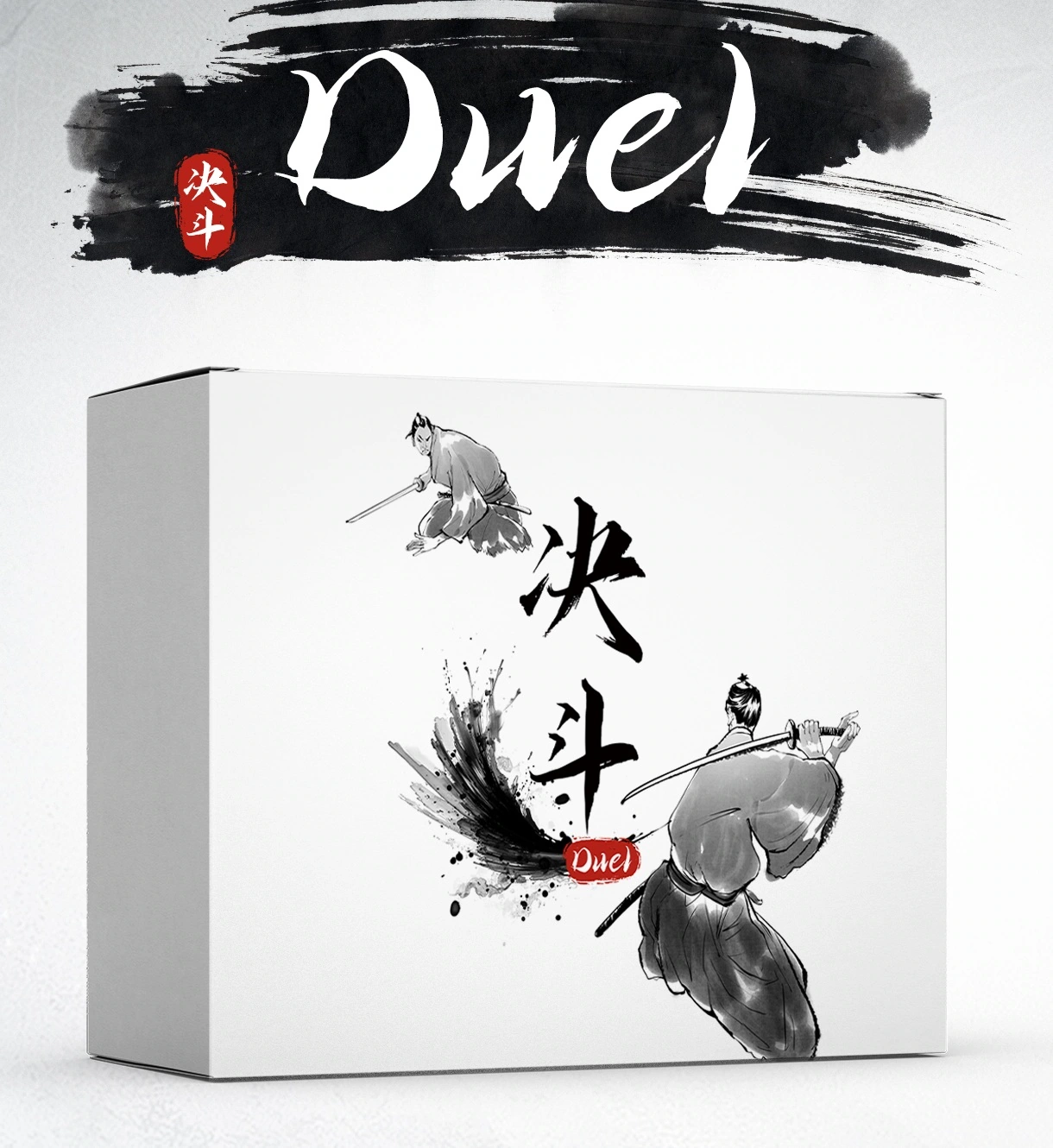
Result
A complete printed game: 109 cards, a 15-space track, a player board and screen for each player, and health and stamina tokens, shown in the box and in play.